

Increased interest by the US Securities and Exchange Commission into tokenized securities suggests that block-chain based financial marketplaces need to ensure that they can manage their operations effectively. However, it is highly possible that the future of stock trading will have nothing to do with the current markets known to investors. This includes the representation of the stocks through digital tokens, their settlement via blockchain technology, and the trading that would take place outside the regular trading hours. However, the regulators are starting to pay close attention to the dangers.
On October 23, 2026, the U.S. Securities and Exchange Commission (SEC) announced its examination priorities for fiscal year 2027, listing tokenization among areas of emerging importance for market infrastructure. According to the report, tokenization has been listed along with new trends such as quantum computing, extended market hours and advanced artificial intelligence. This news is significant in the sense that tokenization is not mentioned explicitly in the SEC's examination priorities for 2026. The listing in the 2027 report indicates that regulators are showing increasing interest in emerging trends as more financial firms turn to blockchain securities. Nevertheless, cryptocurrencies have not appeared on the list of examination priorities in the past two years. It should be noted that the SEC pays special attention to the influence of emerging technologies on securities markets.
What Does the SEC’s 2027 Tokenization Warning Mean?
The annual priorities issued by the SEC’s Division of Examinations inform stakeholders about the potential risks and compliance concerns which the division is going to examine in financial institutions. The priorities serve as the basis for the division's risk-based examination program. They are neither a new set of regulations, nor an indication that all activities mentioned would result in enforcement actions. The SEC's examination priorities for fiscal year 2027 mention tokenization as one of the areas which are to be examined under Regulation Systems Compliance and Integrity, or Regulation SCI. It requires certain standards for capacity, integrity, resiliency, availability and security of the systems important for the market.
Also, tokenization is listed among the other high-risk areas to be reviewed during the examinations of clearing agencies, including securities lending, default management and operational risks.
This is significant because clearing agencies play a role of ensuring the completion of securities transactions. As more tokenized assets will be integrated into the financial markets, technical and settlement issues might impact not just individual clients.
The message of the SEC is not that the tokenization process should be stopped. Instead, financial firms have to show that they can innovate while maintaining market safety.
What Is Tokenization in Financial Markets?
Tokenization refers to the act of creating a digital representation of an asset or security using blockchain or any other type of distributed ledger technology. In the securities market, the token represents ownership interests in a share or a financial right associated with an asset or any form of contract involving securities.
For instance, a business may issue shares in the form of tokens, which means that the business keeps track of its ownership via blockchain technology and not using conventional databases. On the other hand, an external platform may decide to issue tokens for the shares being held by the entity in custody or offer products that track stocks’ performance.
These two types of arrangements are different from each other. This is because the rights enjoyed by the investors will depend on the legal nature of the product, who is the issuer, and any agreements regarding the ownership.
On January 2026, the divisions of Corporation Finance, Investment Management, and Trading and Markets of the SEC issued a statement about tokenized securities. It was clear that tokenization does not change the status of a financial instrument under the federal securities law.
Why Is the SEC Increasing Its Focus on Tokenization?
Tokenization could also enhance the issuance, transfer, and settlement of securities. Nonetheless, bringing novel technologies to well-established financial market infrastructures poses challenges that the regulators must consider. First, there is operational resilience. In case of the interruption of the blockchain system, trading platform or related services because of outages, cyber-attacks, security vulnerabilities, or malfunction in processing transactions, the effect could ripple throughout a number of participating organizations.
Ownership and custody are another potential problem. Investors must be aware whether a token confers on them direct ownership or only an indirect interest in a security, which the custodian holds on their behalf. In case of failure or liquidation of a platform, the answer to the question could determine investors' rights.
Settlement is the next area. While a blockchain transfer may seem instant, the whole process might take time because it involves identity verification, payments, custodians, legal ownership records, among other intermediaries. Faster technologies do not mean reduced risks of settlement.
Moreover, there are concerns relating to liquidity, valuation, cybersecurity, and regulatory oversight. Even if a token could be transferred easily, it might not be traded readily enough at reasonable prices, especially in case of low liquidity and restricted access through particular platforms. These challenges explain why tokenization has become relevant for market infrastructure examinations rather than being just a technology issue.
How Tokenization Could Change Traditional Financial Markets
Tokenization has been getting interest since it can alter the way that investors trade their financial assets.
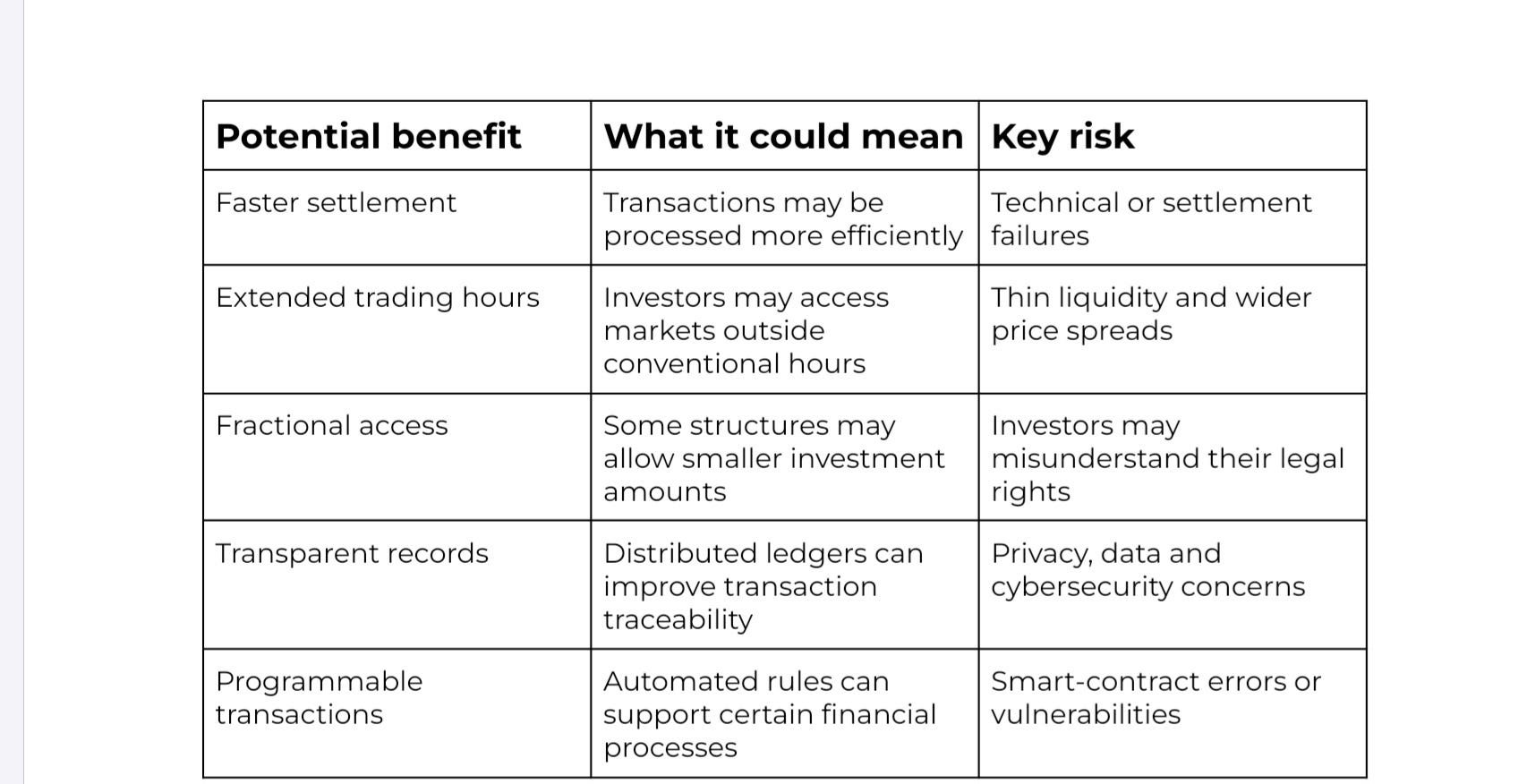
These possibilities, however, depend on how effective the particular technology, market design, regulations, and safeguards of each specific product can be.
Round-the-clock trading does not necessarily ensure that there would always be sufficient amount of buyers and sellers. Moreover, the use of a blockchain does not mean that a token holder would have enforceable rights vis-à-vis the original issuer of the securities.
The challenge for the financial sector is to take the benefits from the digital infrastructure and preserve all the safeguards which ensure the reliability of financial markets.
In the meantime, the SEC’s statement was preceded by the announcements about the collaboration of established financial players and cryptocurrency exchanges regarding tokenized stocks trading. In October 2026, OKX and Intercontinental Exchange (the owner of New York Stock Exchange) attracted public interest with their plans to establish a platform for trading tokenized shares of 60+ US-listed companies.
As described in the report of The Block, the joint project of the two financial giants is expected to provide permissioned on-chain trading and extended market hours. The project proves why tokenization becomes an issue of practical regulation. As financial market operators and digital assets companies begin using blockchain to issue securities, the issues of the rights of shareholders, market oversight, custody, and trading become especially relevant.
Moreover, in January, the SEC made a difference between the issuer sponsored tokenized securities and products issued by third parties. This is essential since the token issued by the company itself can have a completely different relation to the underlying security in comparison to the product issued by the unrelated platform. Therefore, investors should consider the rights provided by the token.
SEC Examination Priorities: 2025, 2026 and 2027
The evolution of SEC examination priorities offers an appropriate framework for interpreting its attitude toward digital assets.
Fiscal year Crypto and tokenization focus
2025 Crypto assets had a dedicated examination
section covering areas including advice,
trading, custody and operational risks.
2026 Crypto assets were absent as a standalone priority,
while broader compliance and technology risks
remained relevant.
2027 Tokenization was explicitly identified within critical
market infrastructure and clearing-agency
examinations.
SEC Priorities for 2025 included crypto asset-related services. In contrast, the 2026 SEC priorities lacked a separate category of crypto-assets. SEC Priorities for 2027 continue this trend but specifically mention tokenization. This key point is that the lack of a crypto assets section does not indicate any exemption for crypto-related activities from the relevant securities legislation and examination. Such activities may still be examined in accordance with rules pertaining to custody, disclosure, trading, financial responsibility, and resiliency. The priorities, however, reflect the focus areas for the examination division rather than an exhaustive list of activities that can be examined by the SEC.
What Does This Mean for Crypto Investors and the Digital Asset Industry?
For investors, the increasing emphasis on tokenization is a call for them to go beyond the technology or hype of the products. Before buying into a tokenized asset, investors need to be clear on what the token stands for, the issuer of the security, where the underlying asset is stored, what rights exist in terms of shares or contracts, and what happens in the case of failure by the issuer, custodian or platform.
In addition, factors such as liquidity, fees, restrictions, investor protections, and relevant jurisdictions need to be considered as well. For exchanges, broker-dealers, custodians and financial institutions, SEC's priorities serve to reinforce the need for good compliance programs, robust technology, disclosures, and procedures in place for risk management.
Tokenization platforms and developers need to think about the interface between the smart contract system and ownership record, error correction and accountability when things go wrong.
Ultimately, the long-term success of tokenization depends not only on technology innovations. For investors to understand and enforce their rights and for the market infrastructure to function reliably under times of stress.
The Bigger Picture: Innovation Needs Trust
The 2027 SEC examination priorities come in the context of an increasingly intertwined environment where traditional finance and digital asset markets meet. Tokenization might provide opportunities for better accessibility, faster transaction processing and new forms of investing. At the same time, there is an increased awareness of the ownership, custody, liquidity, resilience and regulatory concerns around which cannot be solved just by the means of blockchain.
SEC's choice to name tokenization as one of its priorities clearly implies that these considerations become relevant for the proper operation of the securities markets in the US. The crypto industry must interpret this as a sign of a more restrictive attitude towards the blockchain finance rather than complete dismissal. More importantly, it is a warning that financial innovation should take place in line with appropriate regulatory framework and risk management.
As the process of tokenizing securities moves from experiments to a broader adoption, all investors and crypto industry players must pay attention to the technologies and regulations driving the process.
Both crypto markets and financial regulations continue evolving, and seeing the bigger picture is as crucial as tracking the day-to-day fluctuations. Xante allows you to learn more about the trends in the crypto market, track the most popular digital assets and get regular updates on the developments in the industry. Whether you trade Bitcoin, Ethereum, altcoins or the intersections of traditional finance and blockchain, staying informed can provide a valuable advantage.
Explore Xante and subscribe to our newsletter for weekly crypto market news and developments in the industry straight to your inbox.