


A common promise of crypto is that you can store your crypto, get some yield and make money. Passive yield is a huge incentive when investing in stablecoins within DeFi.
But how risky are you making your investment?
As of November 2026 the US three month treasury benchmark is sitting at around 4.2% (Based on the data from US Treasury on the 2nd November). So if your stablecoin is offering you higher yields like 8%, 12% or even 15% then you may be exposed to more risk. This could be due to exposure to loans, market volatility, counterparty risk and complex strategies. The global stablecoin industry was worth around $314.1 Billion in October 2026 so it is becoming important to know where yield is coming from.
Stablecoin Passive Income
Stablecoins like USDC and USDT are created to keep a fairly stable value, unlike Bitcoin and Ethereum. They are not designed to increase in value. In order to receive an income you need to invest in financial products or platforms. There are three main ways to yield from stablecoins.
Lending
Investors deposit their stablecoins onto lending platforms like Aave. Borrowers pay interest for using the funds which get split between the lenders. This depends on the demand from borrowers, liquidity and market conditions.
DeFi Yield Protocols
These platforms use a variety of strategies to create yield. Ethena uses lending, liquidity and derivatives. Their sUSDe product passes on the yield generated by the protocol. This can be influenced by funding rates and yield from the underlying assets.
Tokenised Real World Assets
This gives investors access to tokenised financial assets. This could be US treasuries. The tokens are placed on blockchain networks.
Stablecoin Yield Ladder
Not all yields from stablecoin investments are the same. It is useful to compare the yield to traditional financial benchmarks. The below data is a snapshot from October and November 2026. It is not guaranteed that you will get these rates in the future.
Investment route Reported yield Main consideration
3-month US Treasury 4.21% Government debt benchmark
SGOV Treasury ETF 3.83% Fund and market risks
Tokenised Treasuries 3.62% Redemption and eligibility
DeFi USDC lending 4.90% Smart contract and liquidity
Ethena sUSDe 4.74% Funding and strategy risks
Stream Finance xUSD 15% Historical failed yield product
Sources: US Treasury, iShares, RWA.xyz, DeFi Rate, Ethena and historical Stream Finance reporting.
Comparing reported stablecoin-related yields
Examples of historical yields. The 15% yield from Stream is provided as they were an example of a failed product.
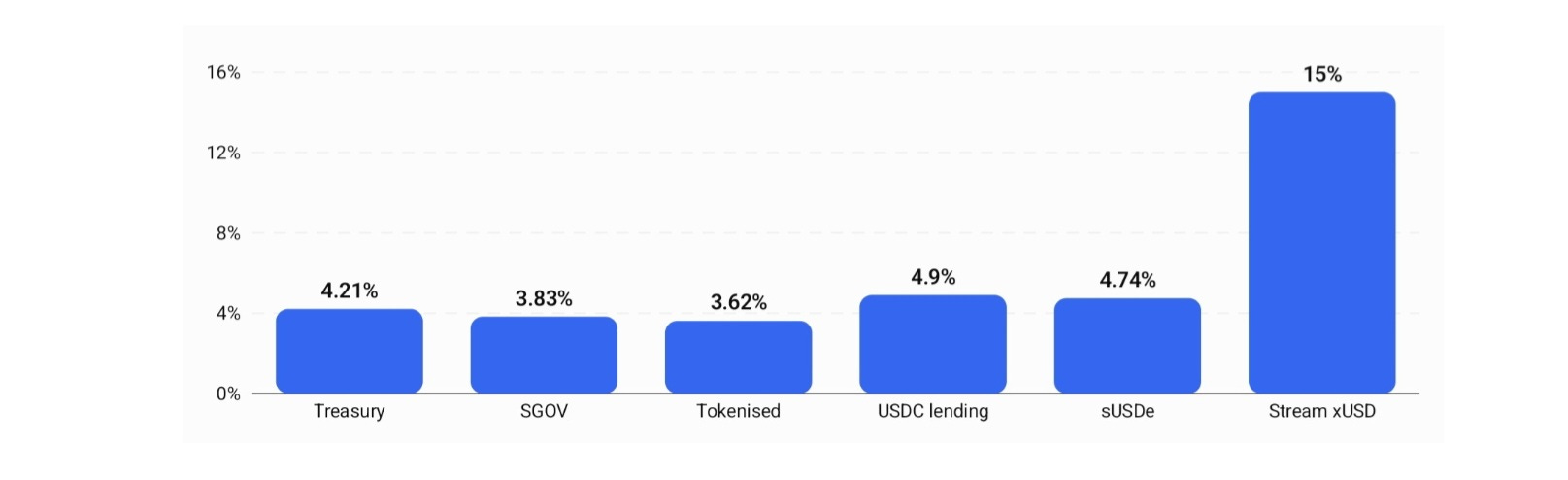
However, these products do not work the same. A treasury backed product will earn yield based on their investment in government debt. With DeFi lending you will earn based on how much interest is paid by borrowers. Higher yields aren’t always a good investment.
Stream Finance: When a 15% Yield Went Wrong
In November 2025, there were clear examples of stablecoin yield risk. Stream Finance admitted that around $93 million of losses were reported by an outside fund manager. It paused deposits and withdrawals and started to investigate. As well as affecting Stream Finance.
Approximately $285 million was seen to be at risk of debt from other lending protocols due to Stream Finance’s assets. As Stream Finance’s synthetic assets (such as xUSD) can be used as collateral for other DeFi products, this creates a risk of the same exposure being spread acrossdifferent lending products. This means if there is a lack of trust in the collateral, lenders and investors will be at risk.
Elixir’s deUSD was heavily impacted as around $68 million (around 65% of total backing) had been loaned to Stream Finance. The price of deUSD dropped to around $0.015. Elixir announced they would be closing the product and trying to redeem users. This shows how a stablecoin can lose its peg if the assets or parties that back them fail.
DeFi Lending: Liquidity Risk
When investing in a lending protocol you may be unable to withdraw your stablecoins immediately if most of the capital is being borrowed. Using Aave as an example, in October 2026 the market data shows that around $2.24 billion was deposited in the form of Ethereum USDC. However, $2.22 billion had been loaned out meaning around 99% of the capital had been used. This leaves only around $20 million unused.
Rates of lending can fluctuate quickly. The amount you earn will depend on how many people want to borrow, how much liquidity there is and how much incentive there is to lend. You should never count on the APY shown. Before investing, look into the terms of withdrawal, how much of the capital is being used, smart contracts audits and how much exposure they have to other products.
Tokenised Treasuries
Investors can invest in Tokenised US Treasuries to get exposure to traditional financial markets on blockchains. In October 2026, there was approximately $14.88 billion invested in Tokenised Treasury Products. These products had an average APY over the last 7 days of 3.62%. An example of this is BlackRock BUIDL. This allows qualifying investors to gain exposure to traditional financial instruments on a blockchain.
It may not offer a high yield but can offer increased flexibility with settlement times, clear ownership records and can be used as collateral. However, it is not the same as investing in a bank account. They can have requirements to qualify, minimum investment amounts, management fees and redemption terms.
Regulation May Impact Yield
There is uncertainty around stablecoin yields. On 15th September 2026 the US Senate did not pass the CLARITY Act as it did not receive enough votes (60 required). This act contained provisions relating to digital asset regulation and stablecoin yields. However, the GENIUS Act is being implemented. In October the Office of the Comptroller of the Currency released the final rule to implement this. It will be in effect from 18th January 2027.
This is important as stablecoin issuers, exchanges and related products may have to structure their reward schemes differently due to future regulations. As an investor you want to know if the yield will still be there if market conditions and regulation change.
Is it worth taking on more risk to earn over 4.2%?
This will depend on your strategy. However, the difference in yield between 4.2% and 4.9% offered by DeFi can be quite small. The extra 0.69% is quite little to take on potentially larger risks. A large loss could wipe out years of extra earnings. The 4.2% is not guaranteed safe yield and cannot be used as a rule for what is safe and what isn’t. It is just useful to compare.
Before investing you should look into where the yield is coming from, the quality of the collateral, withdrawal terms, exposure and whether there is a credible redemption process.
Ultimately, the best yield will not be the highest, but one you understand, can independently research and can reasonably justify the risks you are taking.
At Xante we believe knowledge is power. Get to grips with the numbers behind the headlines. Follow Xante to track the crypto markets, learn about key developments and keep up to date. Sign up to our weekly newsletter and follow US on our socials for more research, updates and real world insights.
Disclaimer: This article is for educational and informational purposes only. It is not financial or investment advice. Stablecoin yields are variable, and digital asset investments can result in partial or total loss of capital.